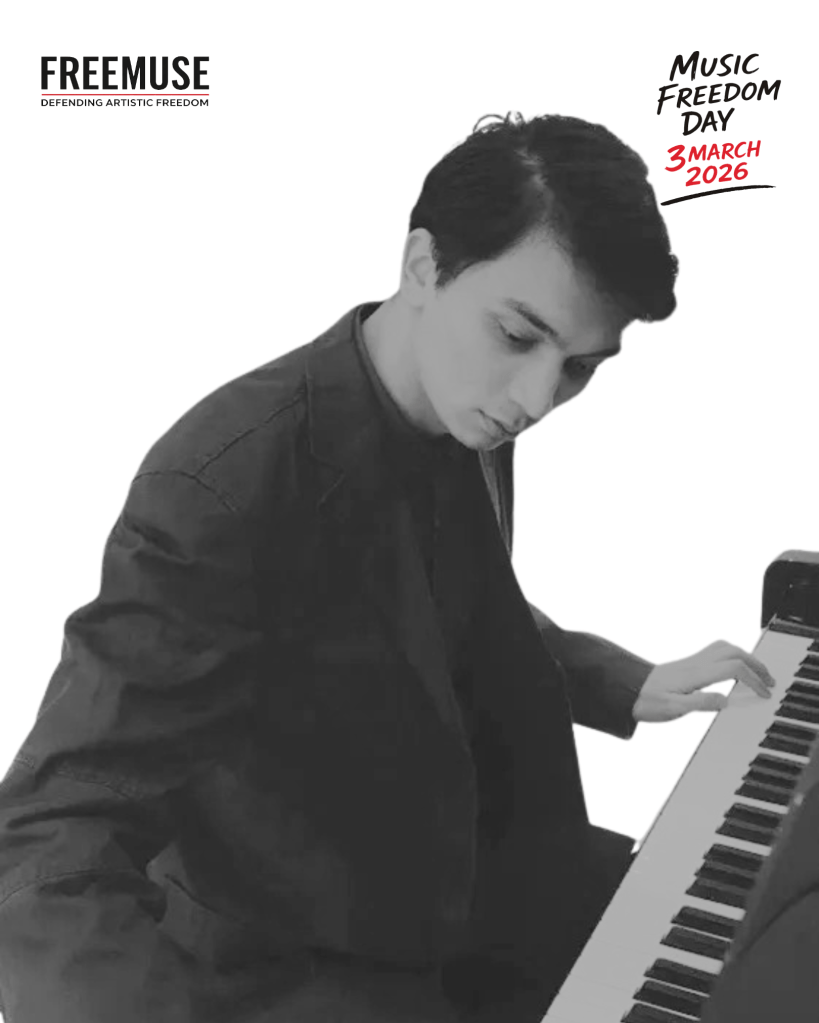
In Chengdu, in southwest China, in late 2022, people gathered on a street by a river. Most wearing masks and dark clothing. Candles were lit. Blank sheets of A4 paper were out. Held at chest height. Raised overhead… The kind you might tear from a notebook and never expect to use as a sign. But the empty page said everything. The gathering belonged to the wave of White Paper protests that followed a deadly apartment fire in the Xinjiang city of Urumqi. Crowds in Shanghai, Beijing, and elsewhere tested the limits of the stringent Zero-Covid policy by holding up the white paper, a symbol of the silence enforced by the authorities. The paper signified, as one protester explained, “everything we want to say but cannot say”.
A young man stepped forward and sang in Uyghur, the Turkic ethnic minority language of China’s Xinjiang region, a lament for the dead. The song didn’t last long before the police stepped in. Yashar Shohret, a Uyghur rapper and songwriter who performs as Uigga (lucky star), was detained for about twenty-one days , on suspicion of “gathering a crowd to disrupt social order”.
Shohret is from Bole, in Xinjiang. He went to university in Chengdu. He made music tracks, uploading them online where young musicians share their work, with the ordinary hope of being heard. He rapped in Uyghur. Not as a political act because it was the language he dreamed in. The language he spoke at home. The language that made him. His creative process mirrored that of other rappers: personal experience, poetic narrative, melody.
What the State Cannot Silence
In 2017, sharing Uyghur songs online in China required Yashar to translate lyrics into Mandarin to prove they were “harmless”. When he posted an early song, he attached a note to the translation and appealed to the reviewers for understanding of his motives. He listed what the song was not. No pornography. No violence. No political subversion. Then what it was. A genuine reflection of his inner thoughts. He signed off with “Peace & Love”.
In his home in Xinjiang, the state’s counter-extremism framework has been used to police ordinary cultural life. Amnesty International describes widespread abuses since 2017 and notes that vague official definitions of “extremism” enable the targeting of Uyghurs for peaceful expressions of identity. Authorities have banned numerous Uyghur songs, including traditional folk ballads and newer tunes, deeming them problematic for promoting religious extremism.
Yashar’s story then moves the way these stories move, by gaps. He was released, to return to ordinary life that is not quite ordinary anymore. Attention that lingers under surveillance. A sense of being watched not just for what you do but for what you are. In August 2023, he was again arrested in Chengdu, and then, according to later reporting, disappeared into a process that became accessible only] from the outside, via activists, lawyers, fragments of paperwork.
The Crime of Creating
On 20 June 2024 the state eventually supplied its reasons for his arrest. Shohret was convicted and sentenced to three years, for “promoting extremism” and “illegally possessing extremist materials”, charges that Amnesty International links to his creative work in Uyghur and to his possession of Uyghur-language books. Shohret reportedly suffers from bronchitis and needs regular medication. Prison is already punishment. Bronchitis in prison is a different kind of sentence.
A verdict obtained by WOMEN我们 magazine, reports that prosecutors treated Shohret’s creative output as evidence: 51 songs on NetEase Cloud Music, 42 flagged as “problematic” and eight e-books purchased via VPN that were deemed extremist. Even after he was detained, the songs he had posted online remained accessible. The state didn’t bother to erase the music. Only the man.
In October 2025, UN experts urged China to end repression of Uyghur and minority cultural expression. And they cited Shohret’s case. They described the pattern: culture treated as a threat, creativity treated as evidence, identity treated as material.
Weeks before his arrest, as his birthday on July 25 approached, Shohret did what he often did and released a short track. “How I long for a normal life”, he rapped, “but the script I’ve been handed is a tragedy”. His sentence runs out in the summer of 2026. He will be twenty-eight.
Music Freedom Day arrives with its familiar language. The right to sound like yourself. The right to sing in the language that made you. Shohret’s story turns that language literal. The one he wrote as Uigga, lucky star.
Listen to the artist’s music:
https://www.youtube.com/watch?v=j0MBS3vpvuU&t=65s
*This article published in Freemuse.
 Musa Igrek